
The gross national debt broke the $39 trillion threshold on March 17, 2026. For comparison, the debt was $34.5 trillion on March 15, 2024, an increase of $4.5 trillion in just two years. This took place without a recession, a large “stimulus” spending package, or a full-scale military operation. In other words, the rapid accumulation of debt is primarily due to structural problems rather than events.
While it took longer for the most recent $1 trillion in added debt (21 weeks) compared to the previous $1 trillion (10 weeks), this is still a troubling pace. Without dramatic legislative action, the debt will reach $40 trillion before the end of the 2026 calendar year and quite possibly before the end of fiscal year (FY) 2026 on September 30. For perspective, the U.S. is not projected to reach $40 trillion in annual GDP until 2032.
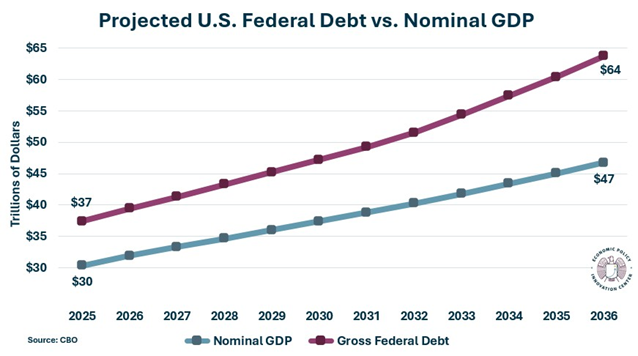
The Heavy Burden of Debt
The numbers surrounding the federal budget can be difficult to properly comprehend, so contextualization is vital:
- Dividing $39 trillion of debt by the roughly 135 million households in the U.S. yields $289,000 in federal debt per household.
- Social Security now has $25 trillion in unfunded liabilities, and Medicare adds another $53 trillion in unfunded liabilities, for a total of $78 trillion – double the current gross debt. That means another $578,000 of red ink per household.
- The Congressional Budget Office projects that the net cost of interest on the national debt will reach $1.04 trillion for FY 2026. That’s $7,700 per household just to cover interest on Washington’s tab. This amount is growing rapidly.
These are not meaningless numbers on a ledger. The broken state of federal budgetary and economic policy affects the standard of living for American families.
- The more than $31 trillion in “public” debt competes with household and business loans in borrowing markets, raising interest rates for everyone. The effect of today’s swollen federal debt adds thousands of dollars of interest costs per year to a typical mortgage.
- Excessive debt is a drag on economic growth. That means slower wage growth and job creation, reducing opportunity for those in the workforce.
- Most federal spending (which drives deficits) is comprised of transfer payments and other forms of subsidies. This puts upward pressure on prices within important sectors such as healthcare, education, and housing.
The ever-expanding debt has ominous implications for federal policy.
- While it is impossible to know the true limit on federal borrowing, America is barreling towards that red line at breakneck speed. This will constrain the federal government’s ability to respond to a crisis and steadily increases the likelihood of an economically disastrous debt spiral.
- It invites conflicts between the Treasury’s management of debt and the Federal Reserve’s work on monetary policy. Pressure on the Fed to reduce interest on the debt by lowering interest rates or purchase treasury notes increases the likelihood of higher inflation.
Congress can prevent a fiscal crisis by reducing the size of deficits. There are several opportunities available for legislators willing to put the country’s needs first.
Opportunity: Pass a Responsible Highway Bill
Authorization for Highway Trust Fund spending expires on September 30, 2026, and reauthorization of this suite of programs (often referred to as the Highway Bill) is typically considered “must-pass” legislation.
Unfortunately, opportunistic Members of Congress have repeatedly used the “must-pass” nature of the Highway Bill to get a free ride for their questionable pet programs. The 2021 version of the package wasted billions of dollars on destroying “racist” highway sections, grants for left-wing activists, an electric school bus boondoggle, and many other poorly-reasoned initiatives.
The highway fund faces a $340 billion deficit from FY 2027 through FY 2036 if Congress maintains excessive spending levels. A new Highway Bill that eliminates wasteful set-asides, refocuses the highway fund on productive infrastructure, and cuts costly red tape can save hundreds of billions of dollars.
Opportunity: Make Use of Reconciliation 2.0
With 10 months left in the current session of Congress, there is ample time to use the powerful tool of budget reconciliation to expedite fiscally focused legislation. 2025’s One Big Beautiful Bill Act included historic welfare reforms that will save more than $1 trillion over the next decade.
While the first reconciliation package was highly productive, many conservative policies were left on the cutting room floor due to a variety of factors. Reconciliation 2.0 would provide another chance to enact these policies and more.
Tackling fraudulent payments, egregious welfare flaws such as categorical eligibility, inequitable funding disparities in Medicaid, and more can provide tremendous deficit reduction, prevent waste, and improve affordability. It would even be possible to enact Highway Trust Fund spending reforms through reconciliation if a traditional Highway Bill breaks down.
Some legislators are hesitant to embark on a second reconciliation push, often suggesting that it would be too risky. Such arguments fail to account for the real risk of continued overspending. The bigger risk to the United States of America is failure to act on well-established problems such as the national debt and allow economic erosion. At a time when the public justifiably complains about the cost of living, addressing unsustainable debt is the productive move for Congress.
Opportunity: Hold the Line on Appropriations
Though FY 2026 appropriations work is still unfinished due to an ongoing fight over Homeland Security funding, Congress will also need to address government funding for FY 2027 in the coming months.
The House Appropriations Committee has expanded the number of agencies eligible for earmarks, which will provide more chances for questionable pork spending to move forward. Meanwhile, the Senate Appropriations Committee continues its practice of problematic earmarks going unchecked altogether. There is a constant flow of special interest lobbyists glad-handling legislative offices in search of “free” money from taxpayers – and many of those lobbyists work for state and local governments..
The Congressional Budget Office baseline assumes that spending will grow year-over-year based on the most recently enacted level. Keeping total appropriated spending flat can lead to hundreds of billions in baseline savings over the course of a decade by lowering expected spending growth.
This would require principled prioritization: allowing core responsibilities such as national defense to grow by a reasonable amount (to keep up with inflation at minimum) while reducing spending on marginal programs and agencies.
Opportunity: Budget for Emergencies
From military conflicts to natural disasters, Congress enacts tens (and sometimes hundreds) of billions of dollars per year in supplementary appropriations. By using a variety of designations, this spending does not count towards annual caps. This results in the discretionary budget becoming a gimmick-prone mess.
It is reasonably certain that President Trump will request emergency funding to address the conflict with Iran. There is also pressure to couple military funding with additional farm subsidies. Setting aside the questionable merits of the latter effort, there is a strong likelihood that Congress will pass an emergency spending package of some type, and that there will be no effort to balance this spending with an offsetting amount of budgetary savings.
Congress has passed trillions upon trillions of dollars in “emergency” spending. While some of this spending was fully justified and some was wasteful or inappropriate, none of it was properly budgeted for, increasing annual deficits and ongoing interest payments. There is a better way.
One method to manage emergency spending would be to establish a notional “account” for each emergency package that must be paid down with budgetary savings over the medium-term (3 to 5 years), accompanied by automatic spending cuts in case Congress fails to enact the savings. This would provide flexibility in true emergencies while discouraging waste and protecting the nation’s fiscal health.
Pump the Brakes
Wasteful infrastructure spending, fraud-riddled welfare programs, and pretending that emergency spending is free have all contributed to the nation’s $39 trillion debt. Ignoring the economic cost of these problems based on misguided political calculations has contributed to the American public’s growing disdain for the institution of Congress. Yet this does not mean that the House and Senate are doomed to repeat the same mistakes endlessly.
The United States of America has overcome far greater obstacles than today’s budgetary dilemma. If its leaders have the wisdom and courage to pump the brakes on deficit spending and slow down our travel on the road to $40 trillion in debt, America will survive this challenge as well.
By David A. Ditch is Senior Analyst in Fiscal Policy at the Economic Policy Innovation Center (EPIC). – March 18, 2026. Link to article